How Long Does Phlebitis Last? Recovery Timeline and Warning Signs
Published 2026-07-09

Ten days ago, a tender red streak appeared along your inner calf. The warmth is fading and the ache is milder — but a firm cord still sits under the skin, and you are starting to wonder whether this is taking too long.
Recovery from vein inflammation follows a surprisingly predictable schedule. Vein specialists at Vein Center Doctor track that schedule in patients across New York and New Jersey every week — and specific day counts separate normal healing from a developing complication.
How Long Does Phlebitis Last?
Superficial phlebitis typically resolves within two to six weeks. Pain, redness, and warmth usually fade in seven to ten days, while the firm, cord-like vein takes three to six weeks to soften as the body reabsorbs inflammatory debris. When a clot is present — superficial thrombophlebitis — complete resolution often requires six to eight weeks.
Those ranges assume the underlying cause gets addressed. Phlebitis driven by untreated varicose veins tends to linger — and to return.
The Phlebitis Recovery Timeline, Week by Week
Healing moves through four overlapping stages. The table below maps each stage to what patients typically feel:
| Stage | Timeframe | What You Notice |
|---|---|---|
| Acute inflammation | Days 1-3 | Redness, warmth, and tenderness peak; the vein feels rope-like |
| Early recovery | Days 4-10 | Pain eases with compression and walking; redness shrinks toward the vein line |
| Remodeling | Weeks 2-4 | Skin color normalizes; the cord softens but remains palpable |
| Resolution | Weeks 4-8 | The cord dissolves; faint skin darkening over the vein may linger for months |
The lingering cord surprises many patients. That firmness is not an infection — it is the vein wall remodeling itself, a slow biological process the body cannot rush.
The same patience applies to skin color. Hemosiderin, the iron pigment released when trapped red blood cells break down, can tint the skin brown for several months before it fades.
What Slows Phlebitis Healing
Four factors reliably stretch recovery past the six-week mark.
Untreated venous reflux. Phlebitis rarely appears in healthy veins. Faulty valves let blood pool in the superficial system, and pooled blood keeps re-irritating the same vein segment. The episode you nursed through July resurfaces in October.
Continued immobility. Bed rest feels protective but works against you. The calf muscle pump drives venous return. Venous return clears the inflammatory mediators concentrated around the healing vein.
Skipping compression. Graduated compression stockings measurably speed symptom resolution. Patients who abandon them after the first comfortable week often watch swelling and aching return by day ten.
Clotting tendencies. Estrogen-based contraceptives, pregnancy, and inherited disorders such as Factor V Leiden slow clot reabsorption. These cases need specialist follow-up, not just patience.
Warning Signs Phlebitis Is Not Healing
Most phlebitis improves week over week. A recovery that reverses direction demands attention.
Contact a vein specialist promptly if you notice:
- Redness or tenderness spreading along the vein after day five instead of shrinking.
- New swelling involving the entire calf or ankle, not just the inflamed segment.
- Fever above 100.4°F, which can signal an infected vein segment — septic phlebitis.
- A second tender cord appearing in a different location on either leg.
Go to an emergency department immediately for sudden shortness of breath, chest pain, or coughing up blood. A clot that extends from a superficial vein into the deep system can travel to the lungs, and a pulmonary embolism is a medical emergency.
Even if your symptoms sit in the gray zone — improving, but slower than the timeline above — a duplex ultrasound settles the question in a single visit.
How Vein Specialists Shorten Recovery
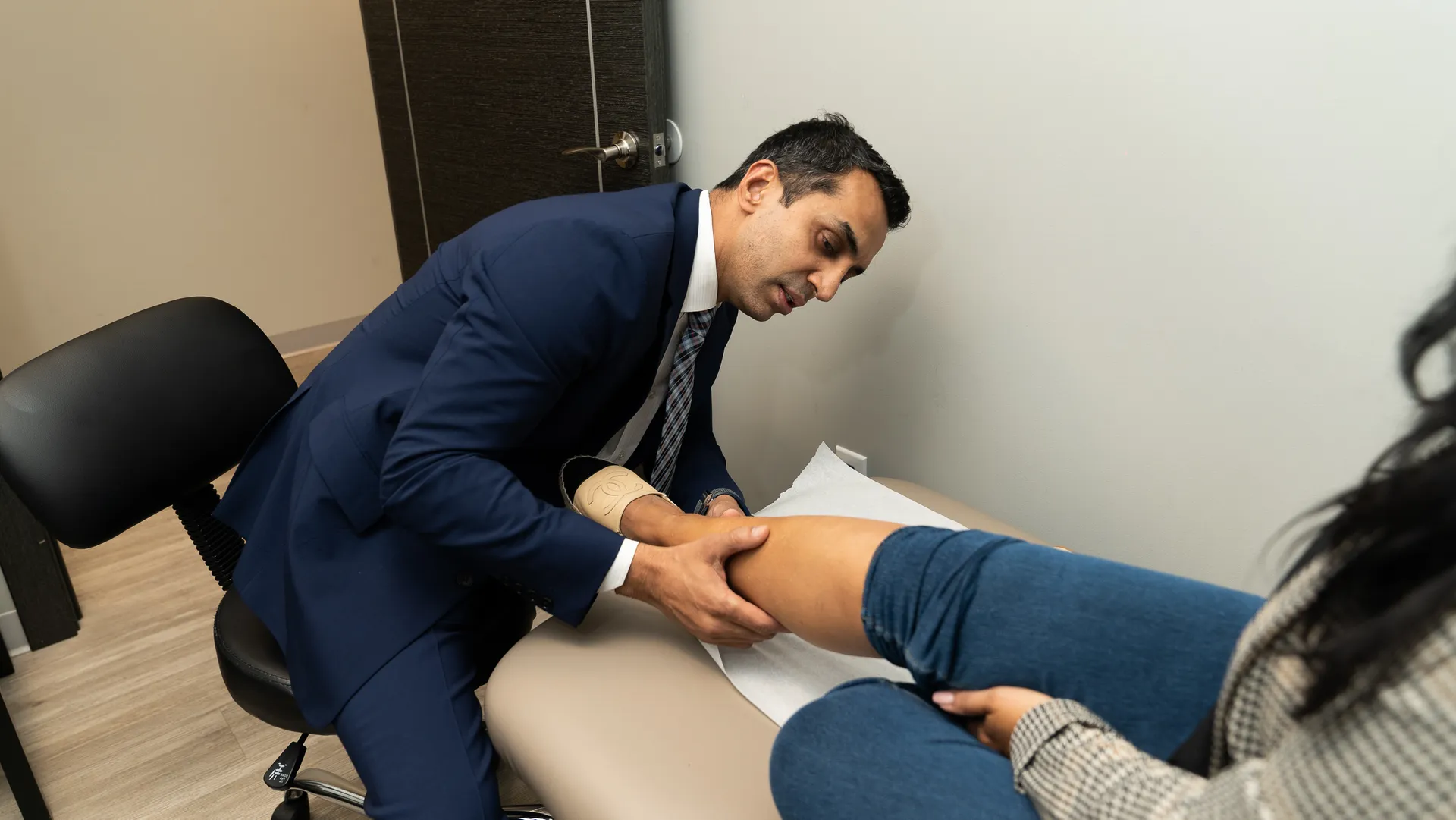
At Vein Center Doctor, treatment starts with mapping exactly where the inflammation ends.
Duplex ultrasound shows whether a thrombus exists and how close it sits to the saphenofemoral junction, the anatomical gateway between superficial and deep veins. Clot position determines everything. A thrombus within 3 centimeters of that junction is managed as a deep venous event.
For uncomplicated cases, the accelerated protocol is straightforward:
- Graduated compression therapy at 20-30 mmHg during waking hours.
- Anti-inflammatory medication for seven to ten days to control pain and swelling.
- Warm compresses on the inflamed segment, 15-20 minutes, three times daily.
- Walking every hour — movement, not bed rest, clears inflammation faster.
Treating the source vein. Once the acute episode settles, Vein Center Doctor's specialists address the refluxing vein that caused it. Radiofrequency ablation seals the incompetent saphenous vein, VenaSeal closes it with medical adhesive, and ultrasound-guided sclerotherapy treats smaller tributaries.
Each procedure is minimally invasive, performed in an outpatient setting, with same-day return to normal activity.
Finally — a recovery plan that targets the vein producing the inflammation instead of waiting out one symptom after another.
Keeping Phlebitis From Coming Back
Recurrence is the real risk. Without treatment of the underlying reflux, the same vein segment stays primed for the next episode.
Movement is the cheapest prevention available. Calf raises, ankle pumps, and a five-minute walk every hour keep the muscle pump engaged through desk days and long flights.
Compression matters most when risk spikes. Wear prescribed stockings during travel longer than four hours, through pregnancy when your specialist recommends it, and during post-surgical recovery.
And treat the varicose veins. A vein that has already produced one phlebitis episode has declared itself dysfunctional — sealing it removes the reservoir where the next clot would form.
Schedule a Free Vein Screening
Vein Center Doctor offers free vein screenings at 12 locations across New York and New Jersey. A board-certified vein specialist maps your veins with duplex ultrasound, confirms your recovery is on schedule, and treats the reflux behind the inflammation.
Schedule your free screening today or call (914) 274-4412. Same-week appointments are available at offices from Ardsley to Edison.